
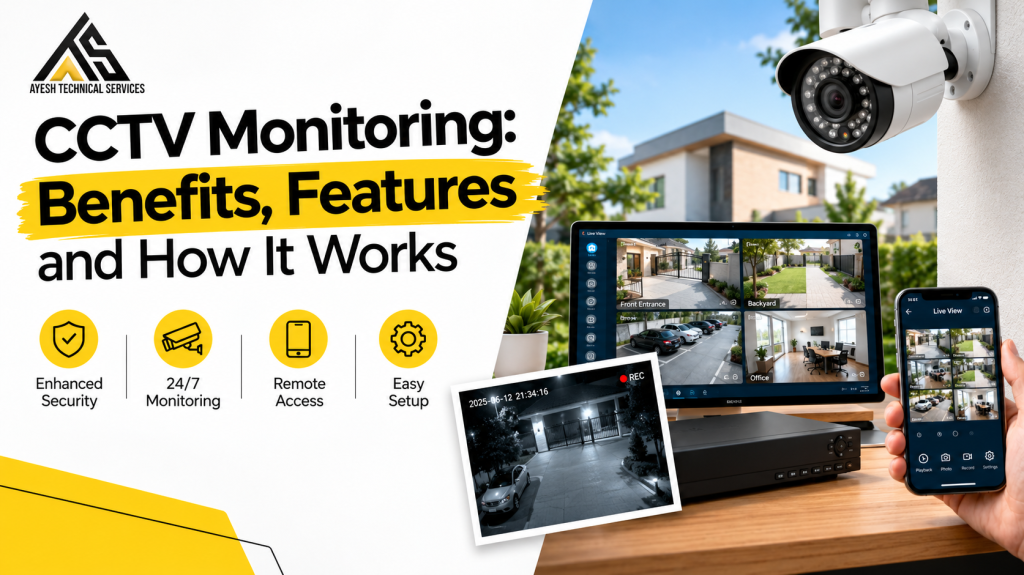
Summary: Explore how CCTV monitoring works, its key features, and the benefits it offers. Learn how live security camera monitoring helps detect security risks, respond quickly to incidents, and keep people and property safe.
A Complete Guide to CCTV Monitoring: How It Works, Features & Benefits
CCTV Security | CCTV Monitor | IT Network
CCTV surveillance helps home and business owners monitor their properties, identify security issues, and take action. This CCTV technology incorporates cameras, recorders, and surveillance systems to give a better overview of what is going on. The type of system being used determines whether individuals monitor it themselves or use a monitoring service.
This guide explains CCTV surveillance systems, how they work, their features, and benefits. It also covers what to consider when buying one in the UAE.
The CCTV surveillance system relies on cameras for surveillance, documentation of activities, and aiding individuals in recognizing possible security threats. Factors such as your property, required camera types, documentation needs, and response time will determine the ideal system.
What Is CCTV Monitoring?
CCTV Monitoring involves the observation of live or recorded footage from security cameras to detect any abnormality or problem. Users can view footage on their phones or CCTV screens. Professional CCTV services may also use operators who monitor footage and respond according to the agreed terms.

This is due to the fact that it is necessary to distinguish between monitoring and recording. The first system records videos for later viewing, while the second allows users to watch events as they happen. Remote CCTV viewing lets you watch camera footage from elsewhere, but it does not necessarily mean someone watches the camera all the time.
For example, a person may check the video feed after receiving an alert. A warehouse company might hire staff to monitor entrances outside office hours.
How Does CCTV Monitoring Work?
However, most CCTV surveillance systems have a very straightforward process from recording to action.
- Cameras monitor activities. Security teams place cameras in key locations, such as entrances, reception areas, parking areas, and building boundaries.
- The system sends the footage to a recorder. The recorder is usually a DVR for analogue camera footage or an NVR for IP camera footage.
- The system triggers recording and alarms based on its settings. Users can set cameras to record continuously, record on motion detection, or send alerts when specific events occur.
- Someone analyzes the recording. This can be the property owner, the security personnel working on-site, or even a professional who monitors remotely. While video analytics may assist in detecting the activity, it may require human analysis as well.
- The team initiates the response plan. Depending on the situation and service agreement, the responder may confirm the incident, alert the site manager, raise an alarm, or contact emergency services.
- Video footage is still obtainable for examination. The recorded video may help determine what occurred and enable an internal investigation or authorized investigation.
The efficiency of the system will depend on camera placement, lighting, quality of footage, connectivity, and the reaction process. Installing cameras alone does not guarantee that the system will detect or prevent every incident.
What Are the Key Features of CCTV Monitoring Systems?
When choosing a CCTV surveillance system, ensure it has suitable cameras, reliable recording, access control, and effective alarms. Consider these factors before choosing the equipment.
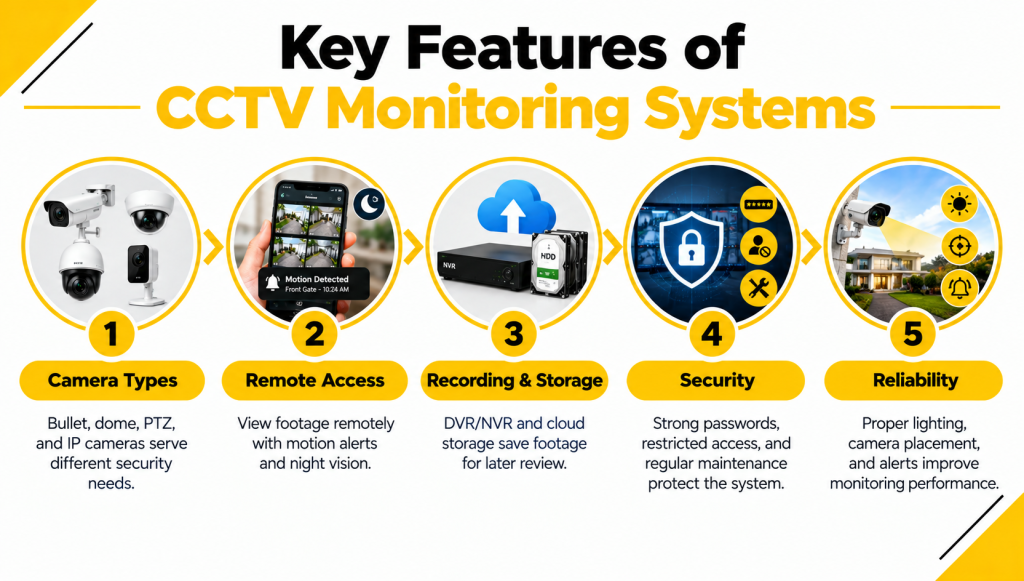
Types of CCTV Cameras
Different CCTV camera types serve different purposes:
- Bullet cameras: Commonly used outdoors for entrance coverage, boundaries, and long viewing distances.
- Dome cameras: Found commonly in shops, offices, and inside spaces where a broad view is important.
- PTZ cameras: Pan, tilt, and zoom for wider coverage, like warehouses or parking lots.
- IP cameras: Digital video transmission over the network and may have the ability to provide remote viewing.
It is important to consider the resolution of the camera, but it should not be the only consideration. Issues like lighting, angles of view, distances, and even installations may come into play.
Remote Viewing and Alerts
Being able to access cameras remotely allows authorized users to view live or recorded footage using their phones or computers. Motion alerts, night vision, and video analytics can make monitoring by security cameras more effective, particularly during off hours.
Users must configure alerts carefully. Shadows, passing cars, and normal movements can trigger unnecessary alarms. Proper setup helps users concentrate on the important information.
Recording, Storage and Reliability
Consider how long you need to store footage and how to access recordings. Also, decide what happens when storage becomes full. Cloud storage allows remote access to footage, while an on-site DVR or NVR gives you more control over recordings.
You should also use strong passwords, limit user permissions, ensure a stable power supply, and perform regular maintenance. For critical security areas, check whether the system alerts you when a camera stops working.
A CCTV monitor can display footage from multiple cameras at a security desk, but it cannot provide professional monitoring services on its own. The security requirements of the facility must dictate the equipment and monitoring system.
What Are the Benefits of CCTV Monitoring?
CCTV surveillance improves property awareness. It also helps people make informed decisions when an incident occurs.

You can maximize the benefits of CCTV surveillance by installing cameras in the right locations and understanding how to respond to incidents.
- Helps prevent crime: Visible cameras can discourage theft, unauthorized entry, and damage, but cannot prevent every incident.
- Supports faster responses: Live viewing and effective alerts may assist responsible individuals to evaluate the situation quickly.
- Provides a record of events: Archived footage may help in explaining an event, damage to property, an argument, or a delivery.
- Enables remote access: Authorised users can monitor their property remotely without being there in person.
- Improves security management: Organizations can analyze movement in the entrance area, stockrooms, and loading zones to determine issues and simplify processes.
A CCTV security system works best alongside other security measures. These include proper lighting, secure doors, access control systems, and alarms.
Where Can You Use CCTV Monitoring?
CCTV monitoring can help meet different security needs depending on how users set up the system.
- Homes and villas: Home CCTV can monitor entrances, driveways, garages, and outdoor areas. Install indoor cameras carefully to protect people’s privacy.
- Retail shops and offices: Cameras can watch entrances, reception, tills, storerooms, and common areas.
- Warehouses and industrial sites: Monitoring can include loading docks, vehicle entry, storage zones, and the boundary of buildings.
- Apartment buildings: Cameras can monitor entrances, parking areas, and shared spaces, in line with applicable rules.
- Construction sites and remote properties: Remote access allows authorised managers to monitor equipment, gates, and activity after working hours.
Identify the main security risks first. This helps you choose the right number of cameras, cover important areas, and record useful footage.
How Do You Choose a CCTV Service Provider in the UAE?
Your security provider should explain the system clearly and assess your property. They should also outline the installation and maintenance process. Do not look at the cost of the camera, but rather at the cost of the services.
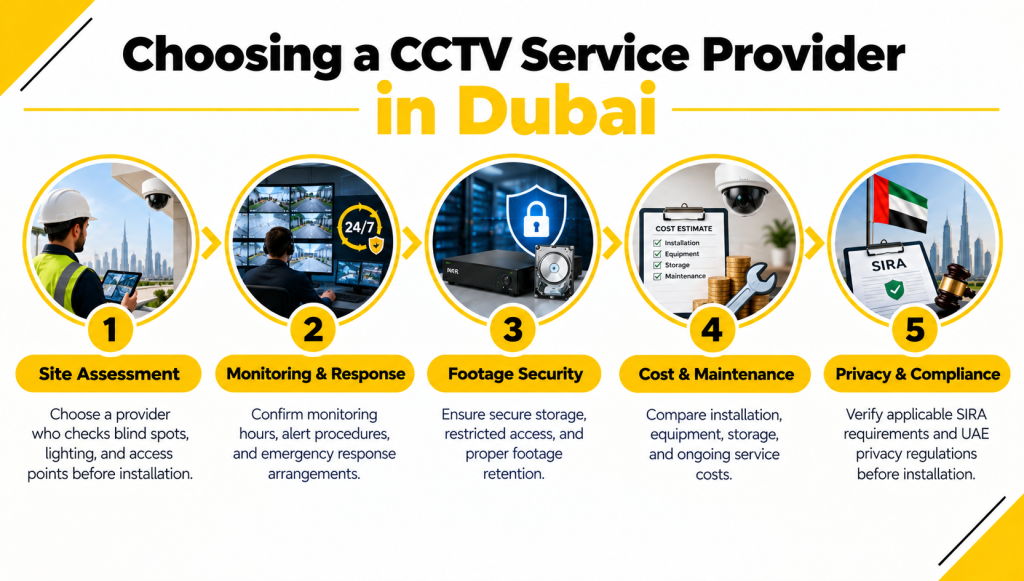
- Request a site analysis: The provider should identify blind spots, lighting conditions, access points, and network limitations before recommending equipment.
- Check the monitoring service: Check what is included in the price, such as recording equipment, remote viewing via the app, on-site monitoring, or a CCTV monitoring service by a professional team. Additionally, clarify the service hours and alert mechanisms.
- Understand the response procedure: Learn who gets the notifications, how the events are verified, and what occurs if the primary contact person is not available.
- Ask about footage security: Confirm who can access the recordings, where the system stores the footage, how long it keeps the videos, and how authorised users can retrieve them.
- Compare total costs: Consider installation, cabling, storage, software, maintenance, replacement components, and any ongoing costs for monitoring.
- Check local requirements: These can differ based on the emirate as well as the type of facilities. For every project in Dubai, review the latest guidelines and requirements. Security Industry Regulatory Agency (SIRA) regulations to determine the approvals required.
In comparing the CCTV monitoring companies, ensure that each company explains its recommendations on the same site requirements. The professional planning of a CCTV surveillance system must cover all these aspects.
CCTV Monitoring in Dubai: Privacy and Compliance
Planning is essential when installing CCTV in Dubai. Ensure the system meets security and privacy requirements. Understand your property’s regulations and decide how to store and access video recordings.
CCTV Requirements in Dubai
When installing CCTV in Dubai, follow the relevant SIRA guidelines. Requirements depend on the property type and surveillance system. Please make sure to verify the guidelines regarding the camera locations before installation.
CCTV Privacy and Footage Protection
UAE data protection laws may apply when CCTV footage contains identifiable information. Only authorised individuals should access the footage. Store it securely, keep it only as long as necessary, and handle recording requests carefully.
Key Considerations Before Installing CCTV
Before choosing a monitoring solution, check the relevant federal, emirate, and industry standards with the appropriate authority. You should consider these issues when setting up any type of CCTV system.
CCTV Monitoring and Other Services by AyeshTech
AyeshTech offers CCTV surveillance and monitoring services in Dubai and the UAE for home, office, shop, and commercial premises. Services offered by AyeshTech include CCTV & IP camera installation, DVR /NVR system, and remote monitoring.

Alongside security solutions, AyeshTech offers property upgrade services. These include carpentry and joinery, interior design and decoration, electrical and electronics, IT networking, and glass and metal works. Visit our blog for helpful information.
Integrated Security Solutions
CCTV systems can integrate with access control systems, alarms, and communication devices to enhance security as well as control access. It all depends on the configuration of the building and its budget.
Installation and Ongoing Support
Proper installation and regular maintenance help keep cameras, recording systems, and connected devices working properly. AyeshTech provides solutions for different property types and project needs.
Conclusion
CCTV monitoring systems help protect individuals and property by enabling them to monitor activities and detect security threats. Your CCTV system choice depends on your needs. Consider camera coverage, resolution, remote access, and maintenance requirements.
To select a CCTV solution that is appropriate for your building, please feel free to contact us.
FAQs
What Is the Difference Between CCTV Monitoring and Recording?
CCTV recording saves video footage for later review, while CCTV monitoring involves watching live footage to detect potential security issues and respond promptly.
Can I monitor CCTV cameras remotely in the UAE?
Absolutely. Suitable CCTV systems allow authorized individuals to watch both live and recorded video on their phones and computers through a secure link.
What should you check before choosing a CCTV monitoring company in Dubai?
Ensure that the coverage, the recording quality, the storage, the remote viewing, and the maintenance services are all checked out.
