
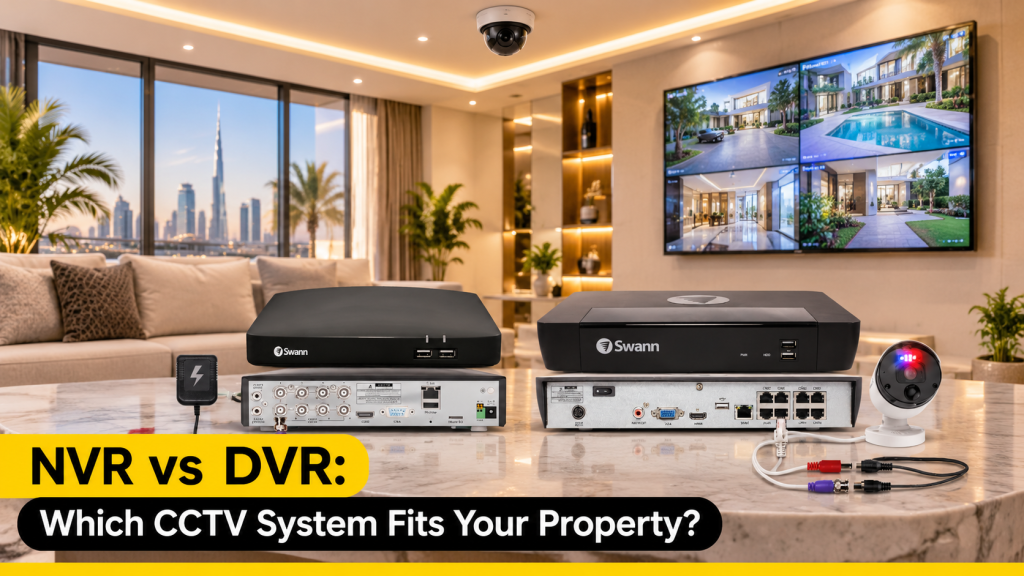
Summary: Not sure whether to choose an NVR or a DVR for your CCTV camera setup? This simple guide explains how each system works, compares their cost, picture quality, and cabling, and shows which one fits your home, villa, hotel, or commercial space in Dubai. It also covers storage, camera placement, and common questions.
NVR vs DVR: Which CCTV System Is Right for Your Property in Dubai?
Picking a CCTV system sounds easy until you start reading the specs. Suddenly you are looking at resolutions, cable types, and storage sizes, and every shop gives you a different answer.
Most of the confusion comes down to one question: NVR vs DVR. Which one should you buy?
Both are boxes that record the video from your CCTV camera setup. You can watch the footage live or play it back later. But they work differently, which affects your picture quality, wiring, and cost.
Whether you own an apartment, a villa, a hotel, or a shop in Dubai, this guide will help you choose.
NVR vs DVR: The Main Difference
The easiest way to understand it is to ask one thing: where does the video get processed?
- A DVR does the work inside the box. Analog cameras send raw video down a cable, and the DVR turns it into a digital file.
- An NVR lets the camera do the work. An IP camera records, compresses, and encodes the video by itself, then sends the finished video over the network to the recorder.
That one difference changes everything else: the cables, the cameras, the picture quality, and how easy it is to add more cameras later.
What Is a DVR System?
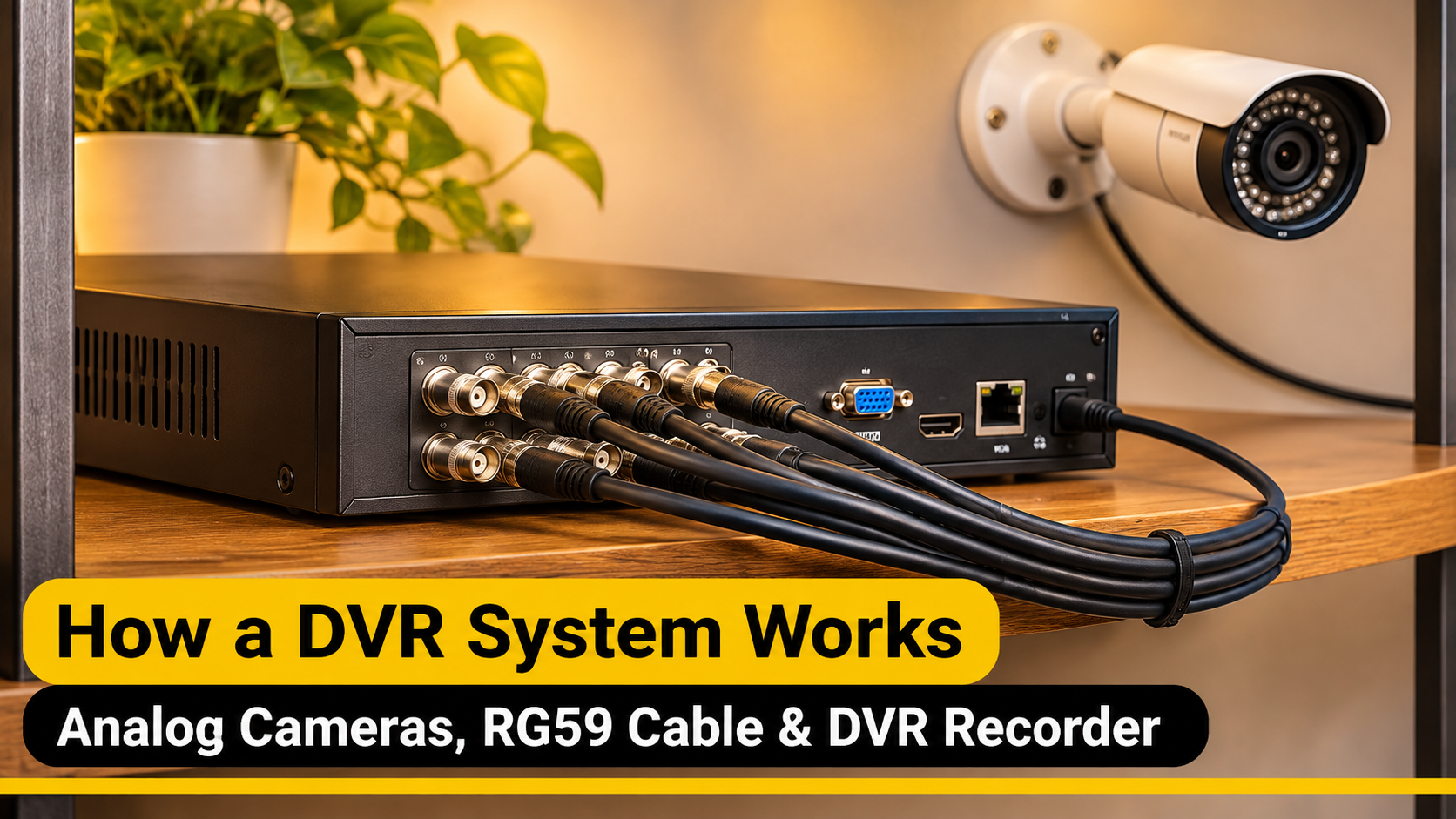
A DVR (Digital Video Recorder) is the older style of CCTV. A DVR recorder works with analog cameras or with newer HD-over-coax cameras.
Each camera connects to the back of the recorder with a coaxial cable, usually RG59. RG59 only carries video, so every camera also needs power. Installers either run a separate power cable or use a combined cable that carries both.
Why Choose a DVR?
- Lower cost upfront. Analog cameras and DVR boxes usually cost less per camera.
- Works with old wiring. If your building already has RG59 cables in the walls, you can often just swap in a new video recorder and keep the old cables. That saves a lot of money and mess.
- Simple to use. You do not need to worry about IP addresses or network settings for basic recording.
- Records without internet. As long as there is power, it keeps recording to its hard drive.
What is not so good
- Messy installation. RG59 is thick and stiff, and hard to pull through tight spaces. The extra power wires add more clutter.
- Limited camera choice. You can only use analog cameras. You cannot plug an IP camera into a normal DVR.
- Hard to expand. A DVR has a fixed number of ports, usually 4, 8, or 16. If you buy an 8-channel box and want a ninth camera, you need a new recorder.
- Picture quality has a limit. HD-over-coax is much better than it used to be, but it still falls behind IP cameras, especially when you need to see faces or number plates. Long RG59 runs can also weaken the signal.
NVR System Explained
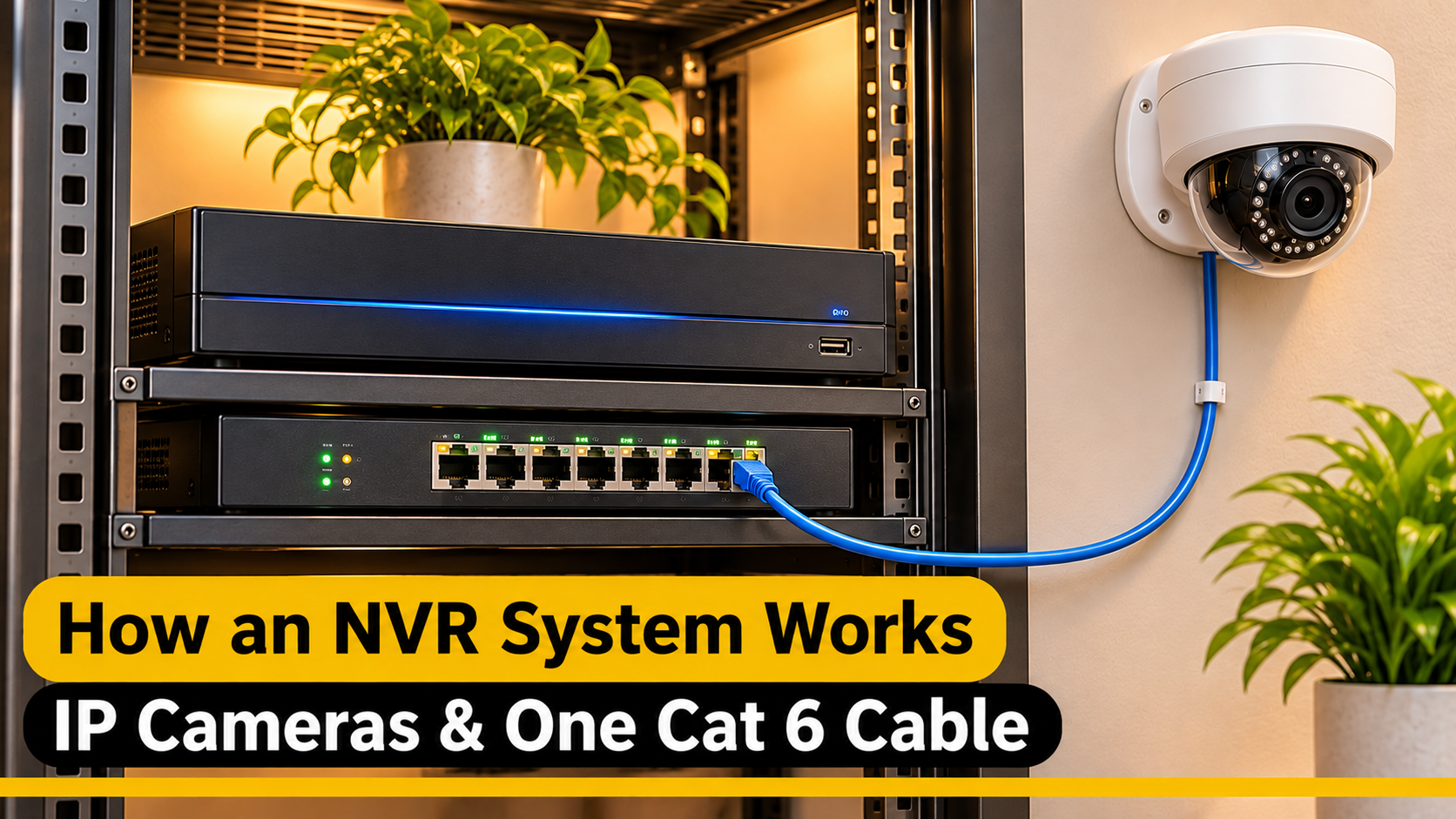
An NVR (Network Video Recorder) is the modern choice. An NVR system works with IP cameras and connects through network cables, or sometimes Wi-Fi.
Most setups use PoE (Power over Ethernet). One Cat 6 cable carries both power and video to the camera, so you do not need a separate power adapter at each point. Cat 6 is a smart pick because it is fast and ready for high-resolution cameras. One cable run can go up to 100 metres (about 328 feet).
What is good about an NVR
- Sharper video. The signal stays digital from start to finish, so 4K cameras are easy to run. When you zoom in on a face or a car plate, the image stays clear.
- Cleaner cabling. One thin cable per camera is much easier to hide than thick coax plus power wires.
- Easy to grow. You can add a network switch on another floor or in another room and connect more cameras to it. You do not have to run every cable back to the recorder.
- Smart features. Many IP cameras can tell the difference between a person, a car, and a swaying tree, and send you an alert only when it matters. Some also have two-way audio.
- Better remote viewing. Checking your cameras from your phone, or managing more than one site, is usually smoother.
What is not so good
- Higher upfront cost. IP cameras and PoE recorders usually cost more at the start.
- Needs a healthy network. High-resolution video needs enough bandwidth and a big enough hard drive.
- A little more setup knowledge. Plug-and-play kits are common now, but mixing brands or adding switches may need some networking skills.
NVR vs DVR: Quick Comparison
| Feature | DVR System | NVR System |
| Camera type | Analog or HD-over-coax | IP cameras |
| Where video is processed | Inside the recorder | Inside each camera |
| Main cable | RG59 plus power | One Cat 6 cable (PoE) |
| Picture quality | Good, up to about 5MP | Excellent, 4K and higher |
| Audio | Needs extra cable | Can run on the same cable |
| Smart alerts | Basic motion detection | Person and vehicle detection |
| Adding cameras | Limited by ports | Easy with network switches |
| Upfront cost | Lower | Higher |
Which One Is Right for Your Property in Dubai?
There is no single winner. It depends on your building, your budget, and what you want your cameras to do. Here is how it usually works out.
Apartments and homes
Either system works if you only need a few cameras, say at the front door and balcony. Starting fresh? A small NVR with PoE cameras is neat and easy to hide. Homes that already have RG59 cables in the walls can often just upgrade with a DVR and skip the mess of opening them up.
Villas
Villas have more to cover: the gate, the garden, the parking area, the roof, and the back door. Cable runs are often long. For most villas, IP cameras on Cat 6 with an NVR give the best result.
You get a clear view at the gate, you can read number plates, and you can add cameras later. For outdoor spots, pick weatherproof cameras that can handle Dubai heat and dust. Look for an IP66 or IP67 rating.

Hotels
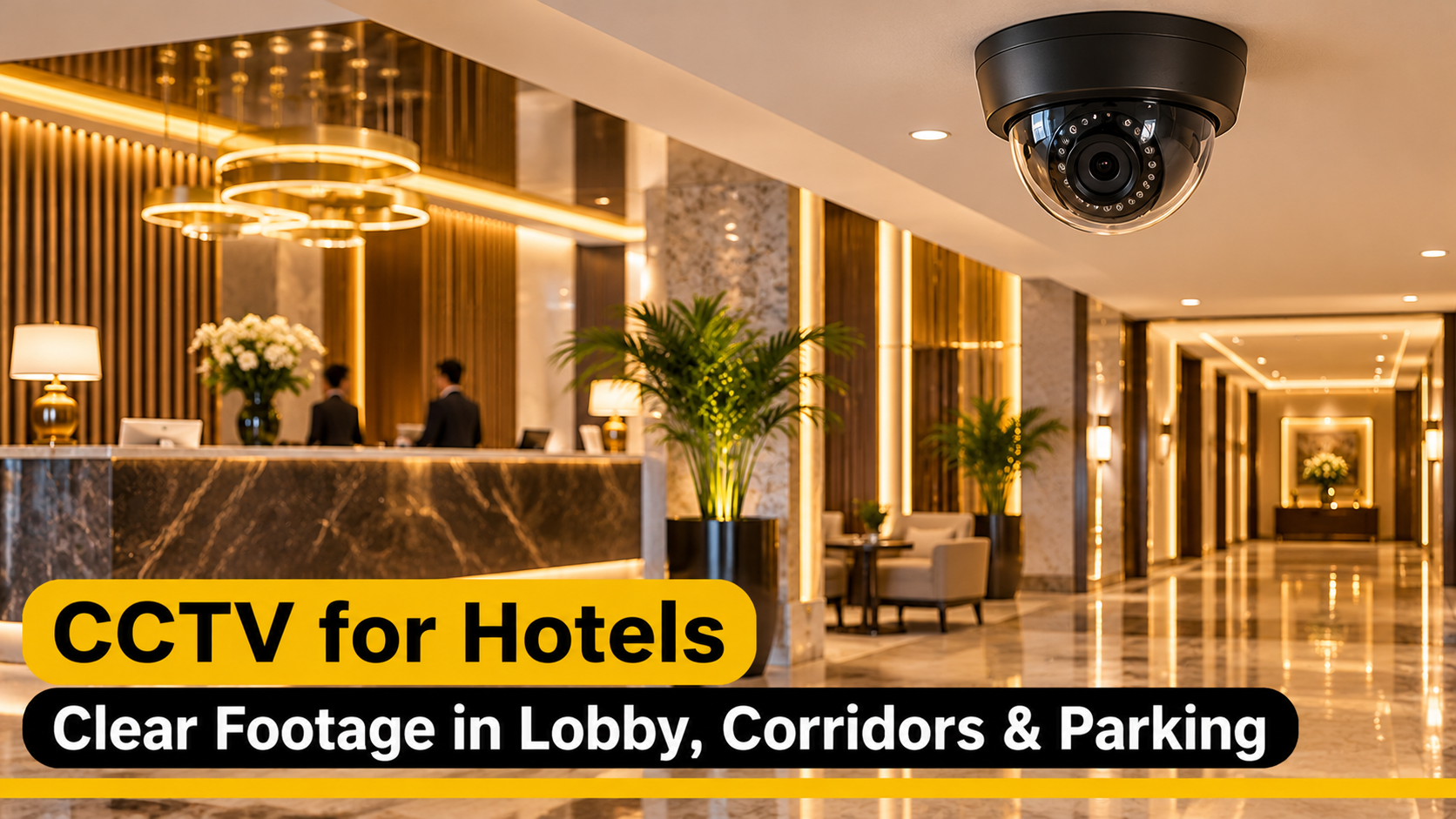
A hotel has many cameras working all day and night: lobby, corridors, parking, back-of-house areas, and entrances. You need clear faces, enough storage for several days of footage, and room to grow. An NVR system with a network switch on each floor is the practical way to do it.
Shops, offices and warehouses
Units that already have coax wiring from an old setup can keep costs low with a DVR upgrade. For a new fit-out, go with an NVR. Need to see cash counters or read number plates?
Choose a DVR if:
- Your building already has RG59 cable in place.
- You have a tight budget and need basic coverage.
- You only need simple motion recording.
Choose an NVR if:
- You are installing a brand-new system.
- Picture detail matters to you.
- You plan to add more cameras later.
- You want clean wiring and smarter alerts.
A Few Things People Often Forget
- Storage. More cameras and higher quality means more hard drive space. Decide how many days of footage you want to keep, such as 14 or 30 days, before you buy the video recorder.
- Camera placement. Think about entrances, gates, parking, corridors, and cash counters. Avoid pointing a camera straight at the sun or at a bright light.
- Backup. Save important footage to an external drive or the cloud, so it is not lost if the recorder is damaged or stolen.
- Good installation. Neat cabling and the right camera angles matter as much as the equipment. A great camera in a bad spot still gives bad footage.
Before you buy, take a look at our CCTV installation and security services to match the right equipment to your space.
AyeshTech: CCTV Installation and Security Solutions
AyeshTech is a CCTV installation and security solutions provider for Dubai residential and commercial properties. We help property owners select and install the right DVR and NVR systems, IP cameras, cabling, and surveillance equipment based on their security requirements, property layout, and budget.
DVR and NVR CCTV Installation
Our CCTV installation services include DVR systems with analog cameras and NVR systems with IP cameras. If you are looking to upgrade an existing CCTV setup or install a new surveillance system, we can help with camera placement, cable routing, recording setup and installation to support reliable property monitoring.
Related Technical Services
In addition to CCTV installation, we also provide services in Electrical and Electronics, IT Networking, Carpentry and Joinery, Interior Design and Décor, and Glass and Metal Works to meet other property maintenance, improvement, and installation needs. Visit our blog to get more useful tips and info on property improvements and technical services.
Conclusion
Choosing between a DVR and NVR system depends on your property’s current setup, security needs, and budget. DVR systems are a practical choice for existing analog cameras. NVR systems offer more flexibility, better image quality, and easier expansion with IP cameras.
Before you install a CCTV system, think about your camera placement, cabling, storage capacity, and future requirements. A good setup can improve security and help you save money. AyeshTech provides installation of CCTV and other technical services in Dubai and helps residential and commercial property owners choose and install suitable security solutions.
For professional CCTV installation or help choosing the right DVR or NVR system for your property in Dubai, contact us to discuss your security requirements.
FAQs
Can a DVR work with IP cameras?
No. A standard DVR is made for analog signals and cannot read the digital video from IP cameras. Only special hybrid recorders can take both types.
Does an NVR need internet to record?
No. An NVR records to its own hard drive even when the internet is down. You only need internet when you want to watch your cameras from your phone or get alerts away from home.
Can I use my old RG59 cables for IP cameras?
Not directly. There are adapters that send network signals over coax, but for the best result, new Cat 6 cable is the better choice.
Which lasts longer, an NVR or a DVR?
Both usually last about 5 to 10 years with normal care. An NVR tends to stay useful for longer because it supports newer cameras and gets firmware updates.
